
OT 652:
This course focuses on professional management and leadership skills and encourages the student to identify personal and professional strengths and areas of growth to become an effective leader. Development of a 5-year professional development plan including goals for advanced practice certifications and fieldwork education are developed. Trends in health care systems, reimbursement, management principles, professional liability, and strategies for supervision are explored. Students will also analyze the professional entry competencies for practice (especially concerning rural practice), including certification and licensure responsibilities.
Meeting Times, Location, & Course Delivery Details
Contact Information
Upon Successful completion of this course...
OT 652 OT Practice Management & Leadership
B.2.9 Create and implement a plan to address individualized personal and professional responsibilities that are consistent with current accepted standards and long-term professional goals. The plan must address the following: • Personal well-being. • Alignment with current accepted norms in occupational therapy practice. • Advocacy related to clients, occupational therapy, or the role of the occupational therapist or occupational therapy assistant. • Long-term career objectives. • A strategy to evaluate, refine, and update the plan over time.
B.2.10 Demonstrate knowledge of the current published American Occupational Therapy Association (AOTA) Occupational Therapy Code of Ethics and AOTA Standards of Practice and use them as a guide for ethical decision making in professional interactions, client interventions, employment settings, and when confronted with personal and organizational ethical conflicts.
B.2.11 Demonstrates knowledge of effective leadership styles. Identify personal and professional strengths and areas for growth to become an effective leader.
B.3.3 Evaluate client(s)’ occupational performance, including occupational profile, by analyzing and selecting standardized and non-standardized screenings and assessment tools to determine the need for occupational therapy intervention(s). Assessment methods must take into consideration cultural and contextual factors of the client. Identify and appropriately delegate components of the evaluation to an occupational therapy assistant. Demonstrate intraprofessional collaboration to establish and document an occupational therapy assistant’s competence regarding screening and assessment tools.
B.4.3 Demonstrate knowledge of various reimbursement systems and funding mechanisms (e.g., federal, state, local, third party, private payer), appeals mechanisms, treatment/diagnosis codes (e.g., CPT®, ICD, DSM® codes), and durable medical equipment coding (e.g., HCPCS) and documentation requirements (e.g., equipment justifications) that affect consumers and the practice of occupational therapy. Documentation must effectively communicate the need and rationale for occupational therapy services.
B.4.9 Develop strategies for effective, competency-based legal and ethical supervision of occupational therapy practitioners and non–occupational therapy personnel.

Occupational Therapy Program Mission: The mission of the Occupational Therapy program at Wilmington College is to prepare exceptional occupational therapy professionals that recognize and respond to the unique needs of rural communities with a focus on evidence and occupational-based practices that are client centered.
Upon completion of the Occupational Therapy program, students will...
Use critical reasoning to recognize health care needs, especially those in rural contexts, and provide evidence-based occupational therapy services to a variety of populations employing a variety of service delivery models, in different health care settings, and within community-based systems.
Provide services within a client-centered, occupational-based theoretical foundation with consideration of the underlying factors including, but not limited to, the culture and contexts that influence the individual’s ability to engage in meaningful occupational tasks and roles.
Clearly articulate, document, and apply professional principles and ethics, in advocacy of the client’s and family’s needs, as well as the needs of the OT profession.
Provide direct and indirect services to promote and sustain health, facilitate typical growth and development, prevent deficits, and maintain, restore, or enhance function through compensation, adaptation, and participation in appropriate therapeutic methods, environmental modifications, use of adaptive equipment, and assistive technologies to enhance meaningful occupational engagement.
Demonstrate the ability to manage and evaluate the efficacy of occupational therapy services including client care outcomes, departmental operations, documentation and reimbursement, and the supervision of appropriate personnel, including fieldwork students, within the guidelines of professional practice.
Initiate and participate in collaborative and cooperative interactions with intra-disciplinary and interdisciplinary professionals, clients, families, significant others, and caregivers to achieve the desired occupational therapy outcomes.
Relationship to Curriculum Design and Themes
The Wilmington College Occupational Therapy Program has a rural focus with three themes woven throughout the curriculum. The three themes reflect aspects of current occupational therapy practice and care and are as follows:
Evidence-Based Practice
Occupation-Based Practice
Client-Centered Care
Week 1 | Topics | Assignments |
Jan. 5-9 | Lecture – Foundations of OT Leadership and Management
| Readings: Jacobs & McCormack Chp. 1 & Chp. 3
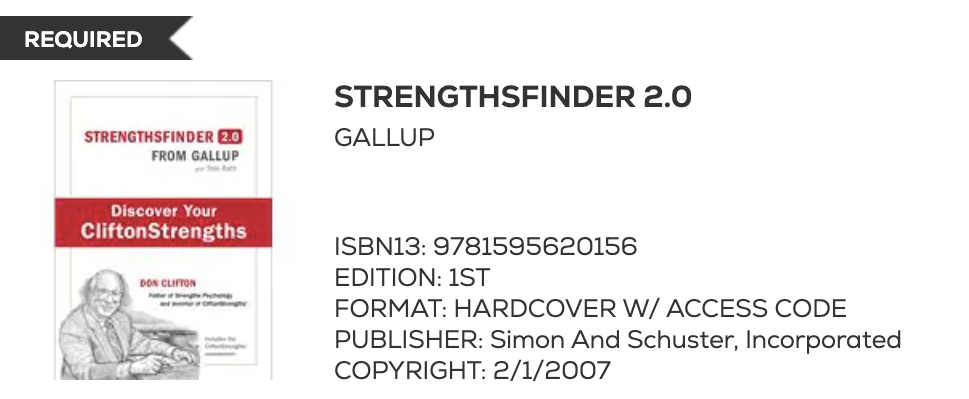
Assignments: Strengths Finder 2.0 (B.2.11) Discussion Post, Due January 11th at 11:59 PM |
Week 2 | Topics | Assignments |
Jan. 12-16 | Lecture – Foundations of OT Leadership and Management
| Readings: Jacobs & McCormack Chp. 6, Chp. 8
Assignments: Quiz 1: Leadership Quiz (B.2.11) |
Week 3 | Topics | Assignments |
Jan. 19-23 | Lecture – Outcomes and Documentation
| Readings: Jacobs & McCormack Chp. 24 & Chp. 26
|
Week 4 | Topics | Assignments |
| Jan. 26-Jan.30 | Lecture – Outcomes and Documentation
| Readings: Jacobs & McCormack Chp. 29, Chp. 30, Chp. 31
Assignments: Quiz 2: Outcomes and Documentation Quiz (B.4.3) |
Week 5 | Topics | Assignments |
Feb. 2-Feb. 6 | Lecture – Billing/Reimbursement
| Readings: Jacobs & McCormack Chp. 74 |
Week 6 | Topics | Assignments |
Feb. 9-13 | Lecture - Billing/Reimbursement
| Readings: Jacobs & McCormack Chp. 63 Assignments: Quiz 3: Billing Quiz (B.4.3) in class |
Week 7 | Topics | Assignments |
Feb. 16-20 | Lecture- Billing Scenarios
| Readings: BB readings Assignments: Billing Scenario (B.4.3) Assignment Due Sunday, Feb 15th @ 11:59 PM
|
Week 8 | Topics | Assignments |
Feb. 23-27
| Midterm Multiple Choice Exam |
Tuesday, Feb. 24th at 9:00 am |
Week 9 | Topics | Assignments |
March 2-March 6 | Lecture – Ethical and Legal Considerations
|
Readings: Jacobs & McCormack Chp. 64
|
March 9-13 | Spring Break | No Classes 😊 |
Week 10 | Topics | Assignments |
March 16- March 19
| Lecture – Ethical and Legal Considerations
| Readings: Jacobs & McCormack Chp. 52, Chp. 61, & 64
Assignments: Quiz 4: Ethics Quiz (B.2.10)
|
Week 11 | Topics | Assignments |
March 23- March 27 | Lecture- Supervision
| Readings: Jacobs & McCormack Chp. 34, & Chp. 41 |
Week 12 | Topics | Assignments |
March 30-April 3
| Lecture- Professional Standards
| Readings: Jacobs & McCormack Chp. Chp. 54 and Chp. 71
Assignments: Quiz 5: Supervision Quiz (B.4.9) in class
|
Week 13 | Topics | Assignments |
April 6-April 10 | Lecture- Professional Standards
| Readings: Jacobs & McCormack Chp. Chp. 37 and Chp. 40
Assignments: Competency Check (B.3.3) Assignment, Due Sunday, April 12 @ 11:59 PM
|
Week 14 | Topics | Assignments |
April 13-April 17 | Lecture- Managing Your Career
|
Readings: Jacobs & McCormack Chp. 69 and Chp. 70
|
Week 15 | Topics | Assignments |
April 20-24 | Lecture- Managing Your Career
|
Readings: Jacobs & McCormack Chp. 67 and Chp. 76
|
Week 16 | Topics | Assignments |
April 27-May 1
|
Finals Week |
Professional Development Plan (B.2.9) Due Sunday, April 26th @ 11:59 PM
|
***Reasonable changes to the course schedule may be made by the faculty or instructor of record at any time during the semester.
Assignment Descriptions | ||
Assignment | B Standard Addressed | Description |
Quizzes | B.2.10; B.2.11; B.3.3; B.4.3; B.4.9
| Students will complete multiple-choice, fill-in-the blank, and matching quizzes to demonstrate knowledge of readings and content covered in class. |
Leadership Profile Discussion Post | B.2.11 | Students will complete a discussion post to share the results of their leadership style quiz. Students will identify their personal and professional leadership strengths and areas for growth. |
Billing Scenario Assignment | B.4.3 | Students will demonstrate accurate billing using CPT, ICD, and DME codes based on a treatment note. Students will document a justification for the equipment and a rationale for OT services. |
Competency Check Assignment | B.3.3 | Students will demonstrate effective supervision of OT and non-OT personnel to ensure competency via written and demonstrated methods. |
Midterm | B.2.10; B.2.11; B.3.3; B.4.3; B.4.9 | Students will complete a multiple-choice exam to demonstrate understanding of leadership skills, healthcare ethics, outcome measurement, and documentation requirements. |
Final: Professional Development Plan | B.2.9 | Students will create a professional development plan to address the following: 1) Personal well-being 2) Alignment with current accepted norms in occupational therapy practice. 3) Advocacy related to clients, occupational therapy, or the role of the occupational therapist or occupational therapy assistant. 4) Long-term career objectives. 5) A strategy to evaluate, refine, and update the plan over time. |
The grading scale will be as follows:
Evaluation Methods | ||
Assignment | Course Grade | Letter Grade Equivalents: |
Quizzes | 20% | A = 90-100 B = 80-89 F = 0-79
*All Complete/Incomplete assignments must be marked “Complete” to pass the class |
Leadership Profile Discussion Post | 10% | |
Billing Scenario Assignment | 15% | |
Competency Check Assignment | 15% | |
Midterm (Written Exam) | 20 | |
Final: Professional Development Plan | 20% | |
| 100% | Total % |
***Please note: A minimum of a “B” is required to pass a class in Occupational Therapy. If the student does not receive a minimum of a “B” in the course, he/she will have one opportunity to re-take the course and pass it when it is offered in the next year to continue to progress through the program. Two failures may result in dismissal.
Methods of Evaluation: Check all that apply
Case Study | X | Presentation |
|
Exams | X | Demonstration | X |
Group Projects |
| Individual Project | X |
Assignments/Papers | X | Essay Test |
|
EBP Literature Analysis |
| Objective Test/Quiz | X |
Lab Performance/Competency |
| Lab Practical |
|
Journaling |
| Participation/In-Class Activities | X |
Fieldwork Performance Evaluation |
| Other: |
|
Methods of Instruction: Check all that apply
Case Analysis | X | Role Play | X |
Roundtable Discussion | X | Clinical Simulations |
|
Discussion Questioning/Interviewing |
| Community Integration Experience |
|
Experiential Learning |
| Multimedia Activities | X |
Fieldwork Experience |
| Other |
|
Group Presentation |
|
|
|
Lecture | X |
|
|
Lab Activities |
|
|
|
Out-of-Class Work Expectation
A minimum of 2 hours of out-of-class student work is expected for each hour of in-class time for traditional face-to-face courses. For online and hybrid courses, the combination of face-to-face time and out-of-class work should be equal to 3 hours per credit hour per week.
Instructor Course Policies
The following professional behaviors will be expected and enforced in and out of class in the WC Occupational Therapy Program at the discretion of the instructor:
| PARTICIPATION |
|---|
| Daily participation is a key part of this course and students are expected to attend all programmed portions of the course. Students are encouraged to communicate with the instructor before class time if any issue arises that may interfere with their ability to participate or require them to step out of the class during unscheduled breaks. Active participation in all daily discussion, community outings, and class/laboratory experiences in this course will be noted by instructors during each session. Students deemed to be disinterested, unengaged, or otherwise occupied, will not receive participation points at the discretion of the instructor with no recourse on the part of the student. Students should arrive prepared for class to discuss, answer questions, and participate in all class lectures, meeting times and activities. Students should make every effort to use the bathroom during scheduled breaks offered approximately once per hour during instruction. If a student leaves the class at other times, it is their responsibility to communicate to the instructor ahead of time of an issue that my prevent them from sitting in class for approximately 60 minutes. Any student who is not engaged in the class, completing other activities not related to the course or the assigned activity, or completing assignments such as studying for another course will be asked to leave the class. Absence, tardiness, and participation points can all be affected by each incident. |
| Absences |
| Instructors reserve the right to determine whether an absence is excused or unexcused. Absences result in 1% off the overall final grade each day the student is absent (e.g., If a student is absent 4 days over the semester, 4% of the overall final grade is deducted resulting in an overall course grade of 96% vs. 100%. Reasonable exceptions may be made at the instructor’s discretion. |
| Excused Absence |
| An excused absence is defined as a student’s unexpected illness/health with a medical note, bereavement for immediate family (e.g., spouse, children, grandparents, grandchildren, parents, siblings), or an unexpected life event (e.g. Emergencies, hospitalizations, and legal obligations). An excused absence will result in the student’s ability to make-up assigned work/assignments and submit within two days for full credit. Reasonable exceptions may be made at the instructor’s discretion. |
| Unexcused Absences |
An unexcused absence is defined as 1.) birthdays, 2.) holidays that are not approved on the Wilmington College graduate calendar, 3.) weddings, 4.) vacations/trips, 5.) absence due to illness without a medical note, or 6.) work. Unexcused absences will result in a student’s inability to submit assigned in-class work on the day of absence. Regular assignments (those that are not completed in-class), and that are due for submission on the same day that a student is absent, MUST be turned in by the due date regardless of whether the student is present for class to avoid a zero grade. In the case of ALL absences, whether excused or unexcused, you are expected to contact your instructor to get information and materials missed. If a student has unexcused absences of 3 or more days of any single course, they can be considered for failure of the course and possible dismissal from the program. |
| Tardiness |
Students are expected to arrive to class or learning session on time including arriving on time after a break in class or learning session. After one late arrival, the instructor contacts the student if the student did not communicate ahead of time regarding the late arrival. Upon the second late arrival, whether excused or unexcused, the instructor notifies the student’s faculty advisor to request the development of an action plan to prevent further occurrences. The student is responsible for any missed material and assignments resulting from tardiness. Failing to notify the instructor of tardiness or absence before class starts, or consistent tardiness may impact your overall grade. Tardiness over five minutes will result in 1% off the overall final grade each day the student is tardy. (e.g. If a student is tardy 4 days over the semester, 4% of the overall final grade is deducted resulting in an overall course grade of 96% vs. 100%. Reasonable exceptions may be made at the instructor’s discretion. |
| Academic misconduct may result in a failing grade, and a letter regarding the incident may be placed in the student’s permanent file in the Office of Academic Affairs. Academic misconduct includes all types of scholastic dishonesty and includes, but is not limited to, cheating on examinations or assignments, interfering with another student’s work, representing work done by another as your own, and plagiarizing. |
| Scholastic Dishonesty |
Any student who commits an act of scholastic dishonesty is subject to discipline. Scholastic dishonesty includes, but is not limited to cheating, plagiarism, collusion, the submission for credit of any work or materials that are attributable to another person. Examples of scholastic dishonesty include: Cheating
Plagiarism
Collusion
|
| Plagiarism |
| Plagiarism is not tolerated and can result in dismissal from the program. Resources are available to help students understand how to avoid plagiarism. Faculty may require students to submit their written assignments through plagiarism software prior to submission. It is the student’s responsibility to ask for help if needed. See the college catalogue and website for further information. |
| Artificial Intelligence |
| You are not permitted to use generative AI tools for any work in courses. This includes the use of popular tools like ChatGPT, Midjourney, GitHub Co-Pilot, as well as all other tools built on generative AI technologies. Due to the nature of this program, work can only be fairly and accurately evaluated if student writing has NOT been assisted by generative AI. Use of generative AI for assignments in this course will be considered a violation of the College’s academic integrity policies. Assigned reading and corresponding written assignments in this program are designed to develop independent skills and thoughtful perspective through reflective technical writing. Use of AI undermines that work, its purpose, and ultimately any benefit that it could provide towards students’ learning experience. Therefore, the use of any generative AI to help with any assignments will be considered cheating/plagiarism and will be graded and handled accordingly. |
| Professional Behaviors |
Students are also expected to be professional in all interactions associated with the school and program. Professional behavior is expected to be maintained in all classrooms and campus buildings, and when in the community for assigned class activities. Unprofessional behavior will be addressed immediately, and the student will be held accountable for immediate resolution of the issue. A process for development and monitoring of professional behaviors has been incorporated into the program. Students will meet (at minimum) each semester with their faculty advisor to review progress towards goals. Students will develop skills in self-reflection and self-evaluation that will support life-long professional development. Behaviors which detract from students learning will not be tolerated. These behaviors include but are not limited to talking during class when an instructor or other student has the floor, attire that distracts from students learning, entering, and exiting during instruction, and incoming messages on electronic devices. |
Additional Course Policies
Americans with Disabilities Act
If you have a documented disability that requires accommodations, contact Spencer Izor, the Associate VP for Compliance: spencer.izor@wilmington.edu, 937-481-2365, or visit her office in College Hall, Room 306.” If it is a class in the Prison Education Program, refer them to the Site Coordinator rather than to Spencer.
Cell Phones
All phones will be turned off/silenced and put away during class and only accessed during break times. If an emergency occurs and the professor is informed appropriately, an exception may be made. Faculty approval is required for any exceptions to cell phone and electronic device use and is at the discretion of the individual instructor.
Dress Code
Students are expected to be always clean and neat. Students are expected to wear polo shirts/collared shirts and khaki, black or casual pants in dark colors during class. No jeans, leggings, or sweatpants are allowed. All clothing must be loose enough to allow free movement through all ranges, especially during lab activities. When participating in anatomy and kinesiology labs students may be asked to change into appropriate lab clothing as designated by instructors. Rubber-soled, close-toed shoes are required. No clogs, flipflops, or sandals are allowed.
Jewelry, perfumes, and after shave scents must be kept to a minimum. When guest speakers or other visitors are present, students must wear their Wilmington College OT Student name tags. Pajamas or tank tops will not be permitted during class, including courses delivered in an online format.
Electronic Devices
The use of electronic devices (including headphones) during class or any instructional activity or session for personal communication, private exploration, or any other purpose outside of the activities prescribed by the Professor for that session is not permitted.
Exams and Quizzes
Any midterm or final assessment CANNOT be rescheduled for an unexcused absence. Time allotted for exams and quizzes will vary between courses. In general, students are allowed two hours for examinations and thirty minutes for quizzes. Official time allotted for exams and quizzes is at the discretion of the individual instructor. In general, students are allowed one hour for multiple choice exams, 30 minutes for quizzes, and two hours for exams containing case studies, short answer items, or essay questions. Time frames for practical exams given individually or in pairs are determined by the amount of content involved and the expectation of the demonstration, at the discretion of the instructor. All students must submit an Early/Late Exam Request Form in order to change the time of their exam for any excused absence. *Free medical and mental health services are available from the Wilmington College Health and Wellness Center. The Health and Wellness Center can be utilized to obtain a medical note (937)-481-2217.
Food & Drink
Any food must only be consumed in breaks, outside or in the student lounge. Students are allowed lidded drinking cups in the classroom. All students are responsible for their own clean up. All kitchen items must be washed and replaced immediately after use. Refrigerators must be emptied of all student items each Thursday before students can leave the building. The program is not responsible for items left in the department over weekends, holidays, or breaks.
Inclusive Learning
Wilmington College is committed to actively pursuing justice and equity for all and in providing an inclusive learning environment that is healthy, safe, and designed to support the success of all participants in their educational pursuits.
Minimal Technical Standards
A student is expected to meet these standards as outlined on the MSOT program’s Minimum Technical Standards document (Appendix B in Student Handbook).
Online Netiquette
Online communication can be challenging. It’s possible to miscommunicate what we mean or to misunderstand what our classmates mean given the lack of body language and immediate feedback. Therefore, please keep these netiquette (network etiquette) guidelines in mind. Failure to observe them may result in disciplinary action.
· Always consider audience. All communication should reflect polite consideration of other’s ideas.
· Respect and courtesy must be always provided to classmates and instructors. No harassment or inappropriate postings will be tolerated.
· When reacting to someone else’s message, address the ideas, not the person. Post only what anyone would comfortably state in a face-to-face situation.
Physical Contact:
Disclaimer: Due to the nature of occupational therapy practice, there may be physical contact with other classmates and instructors in order to fully comprehend and correctly perform specific evaluation and intervention techniques. By reading this statement and signing the syllabus attestation, you agree to fully participate and accept the necessity for physical contact by instructors, guest speakers, and other classmates for professional and educational purposes.-Level Policy item
Face to Face Courses
Wilmington College defines a Face-to-Face course as one which meets in a physical space on a regular weekly schedule. All students enrolled in a Face-to-Face course are expected to physically attend and participate in all class sessions.
Hybrid Flex Courses
In a Hybrid Flex course, you will have a scheduled day(s) each week where you will be required to meet in your scheduled classroom. You will also have assignments and other participation activities that must be completed and submitted electronically each week through the prescribed manner in Blackboard. Participation in the scheduled live class sessions and all weekly course requirements must be completed and submitted electronically in the prescribed manner to the course instructor within the instructors assigned deadlines for assignments and participation that week.
Hybrid Traditional Courses
In a Hybrid Traditional course, you will have scheduled day(s) where you will be required to meet in your scheduled classroom and other day(s) you will participate at the scheduled class time by attending the class live online via the platform specified in your course syllabus. You will have assignments that must be completed each week. Participation in the scheduled live classroom and corresponding synchronous sessions is required. Weekly course requirements must be completed and submitted electronically in the prescribed manner to the course instructor within the instructor's assigned deadlines for assignments and participation that week.
Online Asynchronous Courses
An Online Asynchronous course does not have a set meeting time. Each class week will have participation and engagement requirements that must be completed during that week as determined by your instructor. Wilmington College defines an online course week as one which commences at 12:00 A.M. each Monday and ends at 11:59 P.M. the following Sunday. All weekly course requirements must be completed and submitted electronically in the prescribed manner to the course instructor within the instructors assigned deadlines for assignments and participation that week.
Online Synchronous Courses
An Online Synchronous course will require that you attend the live online synchronous sessions during the scheduled meeting times indicated in your course schedule and in the course syllabus. Each class week will have participation and engagement requirements that must be completed during that week as determined by your instructor. Wilmington College defines an online course week as one which commences at 12:00 A.M. each Monday and ends at 11:59 P.M. the following Sunday. All weekly course requirements must be completed and submitted electronically in the prescribed manner to the course instructor within the instructors assigned deadlines for assignments and participation that week.
Syllabus Attestation
WILMINGTON COLLEGE MASTER OF SCIENCE (MS) IN OCCUPATIONAL THERAPY PROGRAM
Student Syllabus Attestation
Course Name and Number: ________________________________________________________
Semester and Year: _________________________________
My signature verifies that I have received, read, and understand the policies as stated in the course syllabus. I agree to abide by the policies and expectations outlined for this course.
Student Name: _______________________________________________________
Student Signature: ______________________________ Date: _______________
Institutional and Program-Level Policies
All exams will follow the Final Exam Schedule. Students scheduled to take three or more final examinations on one day may request to arrange their examination schedule, so no more than two exams occur on one day.
Requests for early or late exams are considered only under extreme circumstances. Prior to the exam period, the student must file a written request on the Early/Late Exam Form available in the Student One Stop Center, Academic Records, and on the WC portal. The form must be signed by the Instructor and the Academic Dean, approving the alternate exam time. This process must be completed prior to the scheduled exam period.
Undergraduate: SP26 Final Exam Schedule Graduate: